Live Bugs & Worms
Worms: Earthworms or Red Wigglers for Composting?
By WormsMarketplace Editorial Team · Published · 8 min read
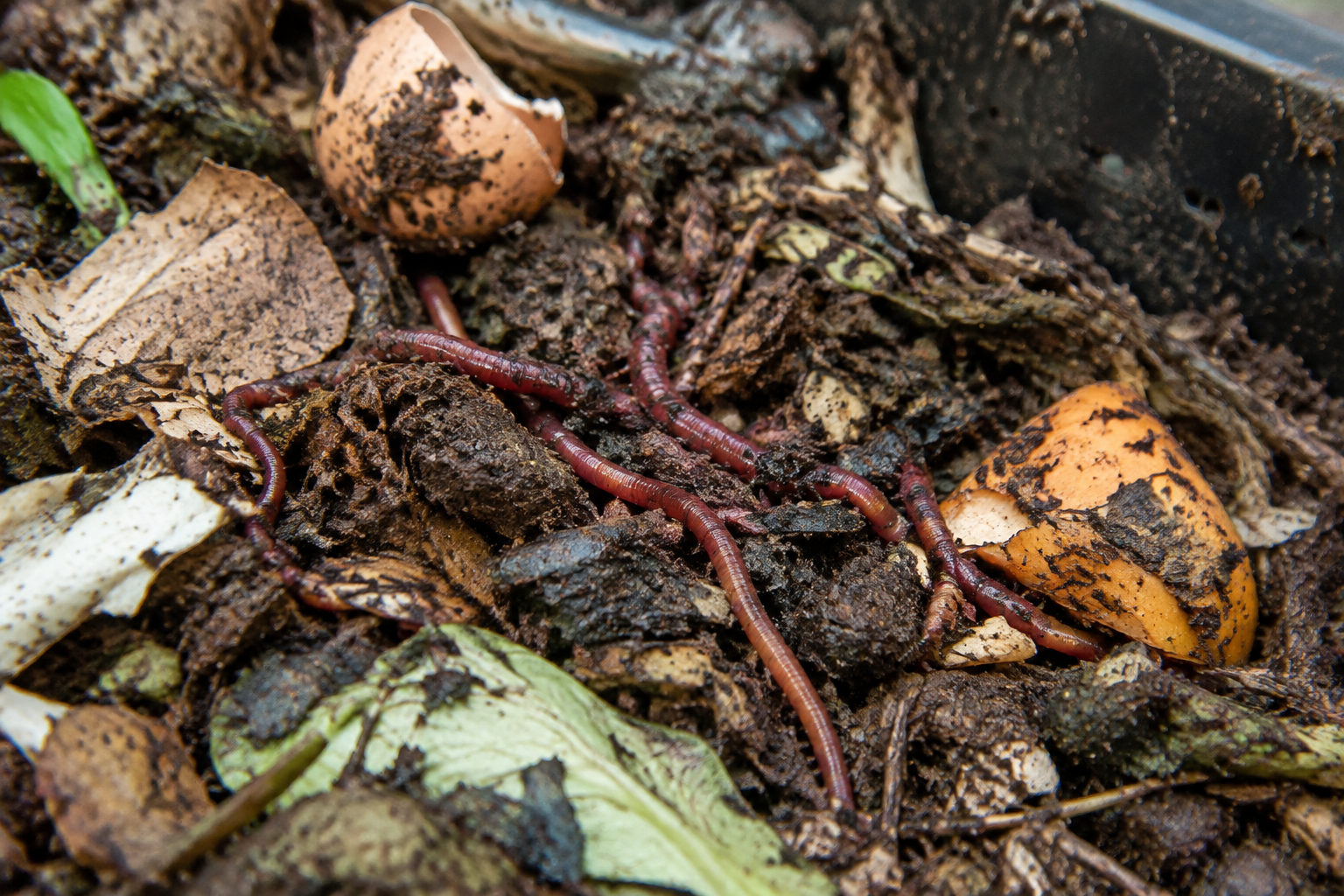
Quick answer: For a home composting bin, red wigglers (Eisenia fetida) are the best-supported choice in the supplied composting guidance. They process food waste and reproduce in confined, air-rich conditions. The important distinction is not simply earthworms versus red wigglers, but whether the identified worm suits composting rather than another habitat or purpose.
Which worms belong in a composting bin?
Choosing compost worms starts with a more useful question than “Which worm is biggest?” Ask which identified worm is suited to processing organic material in a confined bin. Oregon State University Extension describes the common red wiggler, Eisenia fetida, as the usual choice for vermicomposting. [1]
Its suitability comes from the combination of food processing, reproduction and tolerance of confinement described in that guidance. Red wigglers thrive in an aerobic environment, meaning an environment with air, and convert food waste and other organic materials into nutrient-rich compost. [1]
That gives beginners a clear starting point without claiming that every other worm is unsuitable. When comparing worms for worm farm use, look for a scientific name and information relevant to composting, rather than assuming any worm found in soil will do the same job.
Earthworms vs. red wigglers: compare the right things
The phrase “earthworms versus red wigglers” can make this sound like a choice between two equally precise labels. It is not: Eisenia fetida identifies a species, while “earthworms” does not tell you which species you have. The supplied extension sources discuss earthworms with very different environmental effects and uses. [1,7,8]
Some earthworms can improve drainage, aeration, nutrient availability and soil structure, according to University of New Hampshire Extension. However, that source also explains why those familiar benefits cannot be assumed for every earthworm or every ecosystem. A reputation for helping garden soil is therefore not enough evidence of suitability for a composting bin. [8]
Use the comparison below as a selection guide, not a complete identification key. In particular, jumping worms require attention to regional guidance rather than being treated as another interchangeable composting option. [7,8]
| Worm or label | What the sources establish | What this means for your choice |
|---|---|---|
| Red wiggler: Eisenia fetida | Usually used for vermicomposting; processes food waste and reproduces in confined, aerobic conditions. | The clearest supported starting point for a home composting bin. [1] |
| Earthworm, species unspecified | Earthworms differ in their effects on soil and surrounding ecosystems. | Ask for species identification; the broad name does not establish composting suitability. [7,8] |
| Jumping worms: Amynthas spp. | Invasive in the North American regions discussed; can alter soil structure and consume forest leaf litter. | Do not treat them as a substitute for identified compost worms; follow local guidance. [7,8] |
Why red wigglers are useful compost worms
Red wigglers offer a practical match between an animal and a task. Oregon State University Extension describes their ability to process large amounts of food waste and reproduce rapidly in a confined space. Those are directly relevant qualities when the aim is to turn household organic material into compost. [1]
Their digestive system converts food waste and other organic material into a nutrient-rich product described as vermicast or worm castings. However, vermicomposting is not the work of worms alone: the process relies on microorganisms and larger organisms, including the worms. [1]
This matters when setting expectations. A worm bin is a biological decomposition system, not simply a container into which worms and unlimited scraps can be added. The source supports red wigglers as a composting choice, but the excerpt does not establish a universal daily feeding rate or a fixed number of worms for every household.
If you are searching for “worm composting worms”, translate that broad phrase into a specific question: is this Eisenia fetida, and is the care information written for a composting system? That is more useful than choosing from a photograph or a generic worm label.
Worm composting is different from hot composting
Conventional hot composting depends on heat generated by microorganisms, largely bacteria. Its success depends on factors including the carbon-to-nitrogen ratio, moisture and air. Under optimum conditions, Oregon State University Extension gives a timeframe of about six to eight weeks. [1]
Vermicomposting is described as cold composting, with no noticeable heat generated by bacteria during decomposition. It relies on the activity of organisms rather than the heating process used in a conventional hot pile. The same source says finished worm compost can take up to six months. [1]
The difference has a practical consequence: vermicomposting does not destroy weed seeds. Correctly managed hot composting produces heat that promotes decomposition and kills weed seeds, so the two methods should not be treated as equivalent for that purpose. [1]
Choose worm composting because it suits your space, materials and expectations, not because you expect hot-compost speed in a smaller container. Oregon State University Extension notes that vermicomposting can be done inexpensively and in a small space, making it an option worth considering where room is limited. [1]
How to choose worms for a worm farm
A useful selection process separates species choice from system management. First establish what the worms are; then check that the composting guidance addresses the conditions they need. The strongest species-specific recommendation in the supplied material is for Eisenia fetida. [1]
Before bringing live worms home, check local rules and regional extension guidance. Minnesota, for example, treats jumping worms as a prohibited invasive species; that statement is specific to Minnesota and should not be presented as a worldwide rule. [7]
- Confirm the scientific name. For the red wiggler covered by the composting source, look for Eisenia fetida rather than only “earthworms” or “garden worms”. [1]
- Confirm the purpose. Ask whether the worms are being identified specifically for vermicomposting, rather than assuming all worm listings describe equivalent animals.
- Plan for air. Red wigglers thrive in aerobic conditions, so use bin guidance that addresses an air-rich environment. [1]
- Read the relevant care sections. The Oregon State guide includes dedicated sections on bins, bedding, food, harvesting, worm health and troubleshooting. [1]
- Set a realistic timeline. Allow for a relatively slow biological process rather than expecting finished compost immediately. [1]
- Check regional restrictions. Consult local authorities or extension services where species identity or permitted movement is uncertain. [7,8]
Why unidentified garden worms need caution
Finding worms in a garden or compost pile does not establish that they are the red wigglers you want. University of New Hampshire Extension notes that jumping worms may be found in gardens, compost piles and adjacent woodland. Location alone is therefore not a reliable species label. [8]
Both Minnesota and New Hampshire extension sources describe jumping worms as capable of changing soil structure and damaging forest ecosystems. Their consumption of surface organic material can remove the leaf-litter layer on which native organisms depend. Minnesota also describes a coffee-ground-like soil texture associated with their activity. [7,8]
The sources differ in how they frame effects on cultivated plants. Minnesota says jumping worms reduce plant growth and can kill plants, while New Hampshire says the soil changes may not have a major effect on cultivated bedding plants but can be extremely detrimental to native plants and animals. Avoid turning either statement into a universal prediction for every garden. [7,8]
Identification also has limits. Vigorous writhing, snake-like movement and a smooth pale band around the body are described as clues, but New Hampshire warns that visual identification is difficult. Minnesota explicitly says not to release jumping worms into the environment; readers elsewhere should consult their own regional guidance and rules. [7,8]
How to read worm information without mixing topics
The word “worms” covers more than the animals used in compost bins. NIH News in Health, for example, discusses Caenorhabditis elegans, a tiny worm best viewed with a microscope and widely used in biological research. That article is about research biology, not selecting composting stock. [5]
This distinction is useful when searching online: a reliable scientific source can still be irrelevant to your practical question. Information about laboratory worms does not establish a feeding schedule, bin design or suitable composting species. For those decisions, prioritise guidance specifically addressing vermicomposting. [1,5]
Likewise, regional invasive-species guidance answers a different question from a composting guide. Read them together for their appropriate purposes: the composting source explains the intended system, while regional sources explain environmental concerns and locally relevant precautions. [1,7,8]
Set realistic expectations for your first worm farm
The most useful starting plan is straightforward: identify the composting species, understand that it needs air, and allow time for decomposition. Red wigglers have clear support for this role, but that does not make every claim about worm-farm performance equally well supported. [1]
For example, the supplied composting excerpt does not provide a temperature range, bedding depth, stocking density or detailed food list. Use the guide’s relevant care sections for those operational decisions rather than borrowing instructions from unrelated worm species or guessing from a product name.
The goal is a suitable living system, not simply a box containing worms. Start with species clarity and composting-specific instructions, then use local guidance to resolve questions about permitted species and environmental concerns. That foundation is more valuable than choosing worms by size, appearance or a vague promise of faster compost.
Frequently asked questions
Are red wigglers better than earthworms for composting?
Red wigglers, specifically Eisenia fetida, are the usual vermicomposting choice described by Oregon State University Extension. “Earthworms” is too broad a label for a precise comparison. The useful question is whether an identified species is suited to processing food waste in a confined, aerobic bin, which the source explicitly supports for red wigglers. [1]
Can I use worms collected from my garden?
Do not assume garden location establishes composting suitability or species identity. New Hampshire Extension notes that jumping worms can occur in gardens and compost piles, and they can be difficult to identify by sight. For a beginner, identified Eisenia fetida offers a clearer supported choice. Check local guidance and rules before moving unidentified worms. [1,7,8]
How long does worm composting take?
Oregon State University Extension describes vermicomposting as relatively slow, with finished worm compost taking up to six months. It contrasts this with about six to eight weeks for conventional hot composting under optimum conditions. These are process descriptions, not a guaranteed harvest date for every bin; avoid planning around an assumed instant turnaround. [1]
Will a worm farm destroy weed seeds?
No. The supplied composting guidance explicitly says vermicomposting does not destroy weed seeds. It is a cold process that relies on organisms rather than the heat of conventional hot composting. If destroying weed seeds is an important objective, do not assume passing material through a worm farm provides that result. [1]
Are jumping worms another name for red wigglers?
No. The sources identify the common composting red wiggler as Eisenia fetida and jumping worms as Amynthas species. Jumping worms are discussed as invasive earthworms with potentially damaging effects in the North American regions covered. Minnesota specifically prohibits them and advises against environmental release; check the rules and identification guidance relevant to your location. [1,7,8]